|
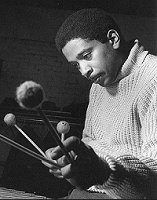
A key participant on many classic Blue Note dates, Hutch brought the vibraphone (and marimba) into the forward looking ‘60s. His career continued steadily from there. Dialogue Apr. 1965 / Blue Note RVG Conversation abounds in this semi-free session. Hutcherson is the nominal leader, yet with all the give and take in the performances, almost any of the six players could be the marquee name. Andrew Hill’s piano creates a lot of heady atmosphere, while bassist Richard Davis brings a strong presence. It could be Freddie Hubbard, trumpeting a new direction for himself, or perhaps drummer Joe Chambers, with his penchant for angular compositions. The only person you wouldn’t finger as the leader is Sam Rivers, who tends to stay in a secondary role on reeds. That leaves Hutcherson, who binds everything together despite not having written any of the tunes. Dialogue’s five pieces sit right on the edge of the avant-garde, though the first two are structurally grounded. Hill’s “Catta” mambo has a prim melody underlined by a trancelike piano vamp, and Chambers’ “Idle While” is an enigmatic waltz with Rivers on flute and Hill sitting out. The traditional rhythms of these two pieces lure the listener into the center of the album, where the trap door falls. The marching theme of “Les Noirs Marchant” dissolves into spiky improv between trumpet, flute, and vibes as Hill tolls fearsome notes and the bass and drums move in fits and spurts. The players build a series of small crescendos, eventually returning to the march cadence and fading out. The title track is next, instruments coming in and out of focus in a democratic exchange of melodic snippets and brief crescendos. Hutcherson steps out with a couple of fragmented marimba riffs. The group plays as if in a vacuum, and improvisation like this doesn’t attempt to signify anything except the process itself. “Dialogue” and “Les Noirs Marchant” are both stimulating examples of musicians closing the songbook and looking to each other for an impetus to play.
The fifth track, “Ghetto Lights”, reverts to bluesy 6/8 terra firma. Hubbard in particular dives into his licks with relish, having been in uncertain orbit for the last two tracks. The CD adds the bonus track “Jasper”, a fun swinger that was not much in line with the tracks chosen for the proper program. As for Dialogue’s place in the ‘60s canon, I think it’s an important experiment in freedom, and it acknowledges a few traditional values as well.
On this album, Hutcherson plays “front line” with vibes and marimba over the support trio of Herbie Hancock, Bob Cranshaw, and Joe Chambers. Herbie reads Hutcherson like a brother; at times, it’s as if vibes and piano are being played by one person with four arms. Before I get carried away with the uniqueness of the instrumentation, though, let’s not forget a group known as the Modern Jazz Quartet. I guess you could call these guys the More Modern JQ. Apart from a sweet version of Hancock’s “Maiden Voyage”, all of the material is written by Hutcherson. The progressive “Aquarian Moon” and the smooth modal ride of “Head Start” stand out. Hutch’s solos on these pieces are very fluent, and so are Hancock’s, especially in “Aquarian Moon”. The Latin-ish “Rojo” sounds a little rote, though I’ll give it the benefit of the doubt. Unfortunately, the ballads are snoozers. The relaxed chord sequence of “Bouquet” comes off as barely more than a sketch and lasts eight slow minutes. At least the maudlin “When You Are Near” finishes in less than half the time.
The album ends with marimba, piano, and drums in a puttering free dialogue called “The Omen”. Not especially rewarding in itself, it provides a final change of pace. Happenings has some fine cuts (“Moon”, “Voyage”, and “Head Start”) and is worth the pickup for Hutch fans, although the draggy ballads keep me from saying it’s solid all the way through
Cool post-bop quartet music with a dash of freedom. Hutch is backed by Herbie Hancock, Albert Stinson, and Joe Chambers on a program that gets more oblique as it progresses. The opener “Til Then” has a frilly melody in a light samba rhythm, and the solos make use of suggestive chord movement. Then comes “My Joy”, a precious waltz of classical feel - somewhat MJQ - and the solos take a heavier turn. Hancock’s piano improv reaches a high peak and spills into Stinson’s bass spot. Hancock’s “Theme From Blow Up” is the hooky centerpiece of the album, sounding like Maiden Voyage Part Deux - elegant rhythm, modal movement, glowing melody. Hutcherson’s “Subtle Neptune” is another samba-based jam on modernist chords. Again, Hancock steps out with a magnificent solo that builds up, winds down, and rebuilds to a second climax. Given all of Hancock’s sideman work in the decade, it’s easy to take his playing for granted, then along comes an album like this that makes you reacknowledge his brilliance.
The last two tracks are credited to drummer Chambers. “Oblique” races into free solos; Hutch does a lot of stop/start phrasing and reaches a tense peak as the bass and drums crash-land their swing. The angular head of “Bi-Sectional” (is that a working title or what?) leads to tempo-less group improv. At one point in this track, Hutch moves to the drum kit while Chambers pounds tympani. “Bi-Sectional” updates the close conversations of Dialogue where the musicians are responsible for their own direction. Overall, this is both a catchy and dangerous album, fueled by occasional atmospheric harmonies (“Blow Up” and “Subtle Neptune”) and Herbie Hancock’s remarkable piano.
|