|
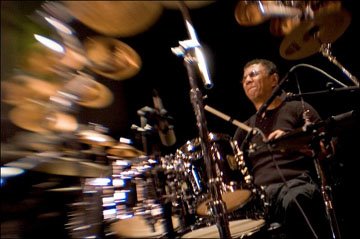
Drummer extraordinaire. Early employers included Bill Evans and Miles Davis. DeJohnette developed his style throughout the seventies and pretty much became a master by the end of the decade. A lot of his finest work can be heard with Keith Jarrett’s standards trio (1983-present), but that’s just one example out of many. New Directions June 1978 / ECM
Almost a dream sequence of music, a hazy continuum with the instruments at once in focus and out of reach, the performances simultaneously earthbound and suspended in mid air. This quartet record is where the already-seasoned DeJohnette really came into his own, playing around the pulse with much individuality. His rhythm partner is bassist Eddie Gomez, whose bouncy lines fit neatly against Jack’s drums. Guitarist John Abercrombie opts for a clean sound and trumpeter Lester Bowie completes the quartet. “Bayou Fever” is indeed feverish, a floating groove topped by Bowie’s lonesome theme call. More mood than tune, it boils up from team chemistry rather than written-down prescriptions. The same can be said for “Where or Wayne”, an exploration wherein the melodic cues are somewhat overshadowed by the atmosphere from which they emerge. Jack’s turvy backbeat on this piece is a treat. The dream-state is intensified in the last three tracks, two of which are light on propulsion and drift gently. The free improv “One Handed Woman” dashes around and finally settles on urban swing with overdubbed handclaps and the vocalized title refrain. New Directions isn’t really fusion by standard definition, but you could call it a progressive jazz album, one that blueprints a possible future. The sound of the quartet is seductive, too - three-fourths acoustic clarity, buffered by Abercrombie’s warm electricity and given extra space by the recording.
In this Swiss concert, the haze of the group’s studio recording disappears but the skeleton remains, as does some of the material. DeJohnette and Gomez punctuate the beat from all sides and dominate the music for the most part. (Fun to realize these guys used to back Bill Evans.) “Salsa for Eddie G”, after a long drum intro, catches the ear with a good groove and various sub-themes. “Where or Wayne” is as hypnotizing as the studio version, but more spread out, and “Bayou Fever” sets up a great expanse, especially with Jack’s piano ruminations in its early stages. “Multo Spiliago” is a completely free exploration yet actually the jazziest track of the four. Overall, solos from the front line are tentative, if not weak. Bowie wanders off mike at times, sounding feeble or slow to get it up. Abercrombie plays well, but his cushy sound conceals itself. I prefer the studio album above, though the two of them make good companions.
A new quartet with David Murray (tenor sax, bass clarinet), Arthur Blythe (alto), and bassist Peter Warren. The way they balance classic swing and avant-garde extremities is amazing, and it’s hard to say if the music leans in one way or another. It probably appeals more to those inclined toward freer jazz. The suite-like progressions of “One for Eric” and “Zoot Suite” cover a lot of distance, sometimes bright, sometimes mournful, usually swinging in a good natured way. Credit to Jack for originating this unique music, but where in the world did it come from? The imprints of Duke and Mingus are certainly there, but so are the voices of the ‘60s free blowers (in the solos), and on top of it all are the idiosyncrasies of the musicians involved. After the showpieces come nine minutes of Trane devotion in a brief and beautiful “Central Park West” (Jack plays melodica) and “India” (where Jack briefly plays piano). They’re two of the best Coltrane covers you’re ever going to hear, getting right to the heart of the music. The finale “Journey to the Twin Planet” starts with spaced-out threads and hurtles into an explosive wormhole. It’s the most abstract piece of the five, and a logical denouement to all the hints dropped in the first four. This very “special” album entwines the past and future and winds up in its own time zone.
Michael Cain (piano), Jerome Harris (electric guitar and acoustic bass guitar), and Don Alias (percussion) join DeJohnette for a program of intimate, ambient sketches. “Jack In” is the only piece with a real hook and structure; apart from that, passive pieces like “Free Above Sea” and “From the Heart” proceed on the barest of stimuli from the leader’s drumkit. Harris usually lies in wait until Cain establishes a tentative harmonic area, while Alias contributes tasty decorations and punctuations. DeJohnette is content to let the pieces grow organically, never rushing. He stays on the ride cymbal for the longest time in “Free Above Sea”, and such patience pays off in the moments that blossom into something more complex.
Since no one is forthright in pushing the others, small fluctuations take the place of big dynamics, especially in the long suite of “From the Heart” and “CMA” that builds up layer by reactive layer. Oneness plots another new direction for the leader, but the irony is that there is little direction from the leader, thus the band moves gingerly through improvised conversations that don’t have a lot of momentum. You can hear right through the music if you listen too closely or often, yet it’s still lovely in places.
|